

Cycles of Conflict: Prophecy, Commodity Waves, and the post ~2055 Global Threat
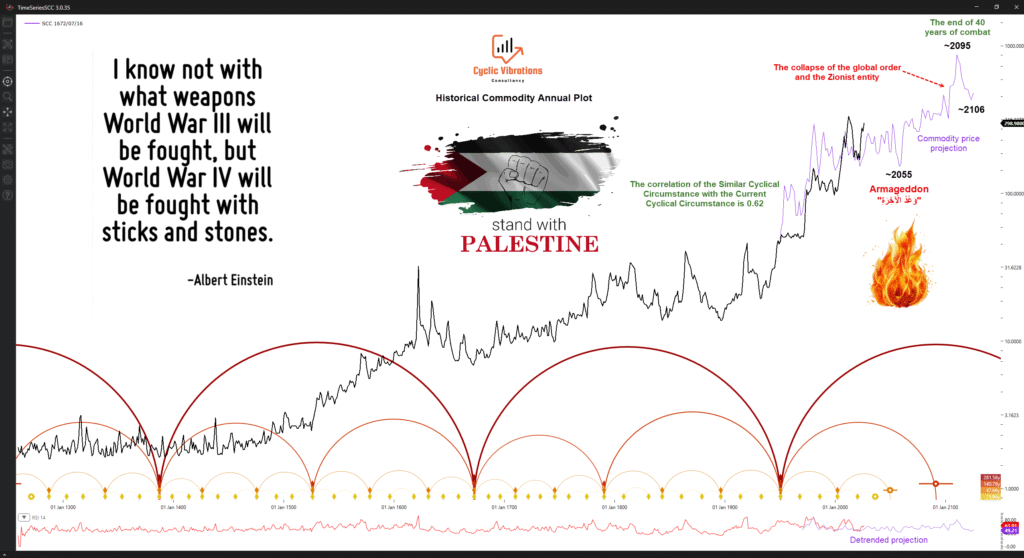
The repetitive cycles of global and civil conflict
This statement presents a particular, cyclical view of history, drawing parallels between current events and past historical conflicts based on a modified interpretation of the Kondratieff Wave and related long-term cycles.
Here is an explanation of the key concepts and analogues:
1. The Core Concept: Cyclical Threat and ~2055
- Kondratieff Cycle (K-Wave): Also known as the long wave, this is a hypothesized 40- to 60-year cycle of boom and bust in modern world economies. The statements presented in the image suggest that this cycle is a great indicator of times of conflict and of peace, as was first presented by researcher Joshua Goldstein.
- The Threat: The text claims that the start of the next Kondratieff cycle, projected for around 2055, will put human existence in serious threat.
2. The Analogues of the Upcoming Kondratieff Cycle (2055-2106/7)
The statement uses four “analogues” (or comparisons) to past historical events to define the current and upcoming periods of instability:
| Analogue Name | Associated Event(s) | Historical Significance (According to the statement) |
| Kondratieff Analogue (Current/Recent) | The War on Terror | This suggests the current/ending cycle is characterized by asymmetrical conflict, ideological warfare, and regional instability, matching the post-2001 era. |
| Hegemonic Analogue | WWI and WWII | This period is defined by massive, world-spanning conflicts over hegemony (global dominance) and the restructuring of the world order, often involving great powers. |
| Enoch Analogue | Wars culminating with the American Revolution | This refers to a period of instability and change in the “New World” (the Americas), marking the decline of old colonial structures and the rise of a new independent state. |
| Methuselah Analogue | The Battle over Jerusalem leading to the Expulsion of the Crusaders | This refers to a very long-term period of conflict (decades of combat) over a pivotal spiritual/geopolitical site, culminating in the complete removal of a foreign presence from the Middle East. |
Summary of the Theory
The underlying theory suggests that history moves in predictable cycles, and by observing past patterns (the Hegemonic, Enoch, and Methuselah Analogues), we can anticipate the nature and outcome of the current (Kondratieff) and upcoming cycles in the future.
The first book of the Tanakh
The analogy between the Methuselah event (Crusader expulsion from the Middle East) and the projected 2055-2095 conflict (as seen in the image, “collapse of the global order and the Zionist entity”) strongly makes us believes the next cycle will culminate in a similar, decades-long, pivotal conflict centered in the Middle East that fundamentally restructures regional and global power.
The Cyclic Model of the Economic Wave Theory
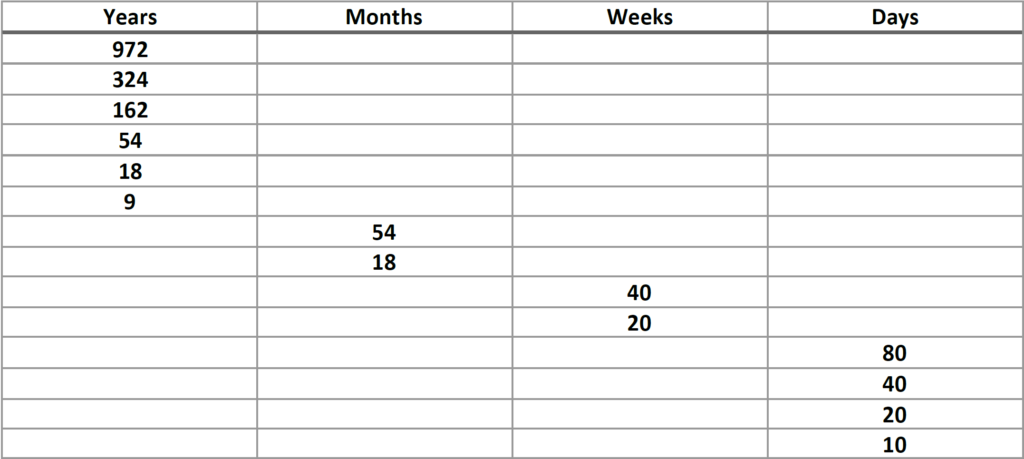
Based on our calculations, the beginning of the forthcoming Kondratieff wave cycle is projected to coincide closely with the outbreak of World War III in full force. We anticipate that this conflict will not be a brief global war, as was the case with WWI and WWII. Instead, we project that the combat will be protracted, lasting for decades and culminating around the year 2095. Following this period, global exhaustion is expected to prevail, leading to a peace agreement and the establishment of a new global leader.
Regards,
Ahmed Farghaly
Founder & CEO of Cyclic Vibrations Consultancy
Recent Comments